Rooftop Solar vs Ground-Mounted Solar: Pros and Cons
As more homeowners, businesses, and industries adopt solar energy, one of the most important decisions before installation is choosing the right type of solar system. While both rooftop solar and ground-mounted solar systems generate clean, renewable electricity, they differ significantly in terms of installation, cost, efficiency, maintenance, and space requirements.
A rooftop solar system is installed directly on the roof of a house, commercial building, or factory, making it the most popular choice in urban areas. On the other hand, a ground-mounted solar system is installed on open land using specially designed mounting structures. It is commonly used for large residential properties, farms, commercial facilities, and utility-scale solar projects.
Both options have their own advantages and limitations. The right choice depends on factors such as available space, budget, roof condition, energy consumption, future expansion plans, and local environmental conditions.
In this comprehensive guide, we’ll compare rooftop solar and ground-mounted solar systems, explain their advantages and disadvantages, and help you determine which option is best for your property.
1. What is a Rooftop Solar System?
A rooftop solar system consists of solar panels installed on the roof of a residential, commercial, or industrial building. The panels capture sunlight and convert it into electricity using photovoltaic (PV) technology.
The system typically includes:
Solar Panels
Solar Inverter
Mounting Structure
DC and AC Cables
Junction Boxes
Net Meter (for on-grid systems)
Earthing and Lightning Protection
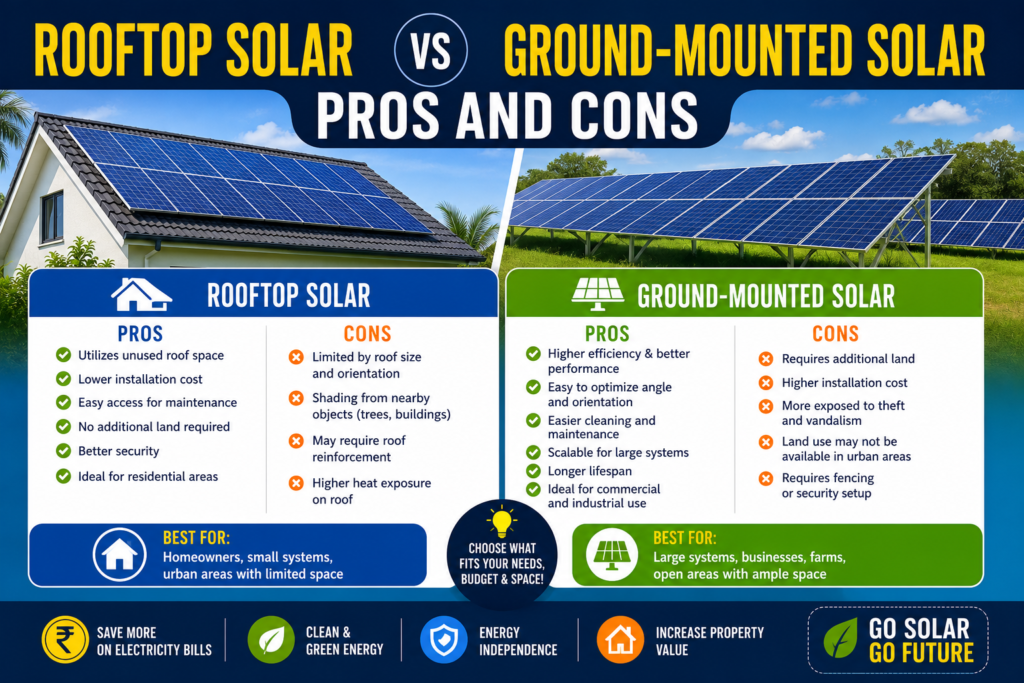
Advantages of Rooftop Solar:
Makes use of unused roof space
Lower installation cost compared to ground-mounted systems
Suitable for homes and small businesses
Eligible for rooftop solar subsidies (where applicable)
Helps reduce electricity bills through net metering
Disadvantages:
Limited by roof size
Roof orientation may affect efficiency
Difficult to expand if roof space is insufficient
Maintenance can be more challenging on steep roofs
2. What is a Ground-Mounted Solar System?
A ground-mounted solar system is installed on open land rather than on a rooftop. Solar panels are mounted on metal structures anchored to the ground and positioned for maximum sunlight exposure.
These systems are commonly used for:
Farmhouses
Large residential properties
Factories
Commercial campuses
Agricultural land
Utility-scale solar farms
Advantages of Ground-Mounted Solar:
Flexible panel orientation
Higher energy generation potential
Easy access for cleaning and maintenance
Easier future expansion
Better airflow improves efficiency
Disadvantages:
Requires available land
Higher installation costs
Additional civil and foundation work
Land preparation may be required
Ground-mounted systems are ideal when sufficient land is available and maximum power generation is the priority.
3. Rooftop Solar vs Ground-Mounted Solar: Key Differences
Although both systems use the same solar technology, they differ in several important ways.
| Feature | Rooftop Solar | Ground-Mounted Solar |
|---|---|---|
| Installation Location | Building Roof | Open Land |
| Space Requirement | Roof Area | Dedicated Land |
| Installation Cost | Lower | Higher |
| Maintenance | Moderate | Easier |
| Expansion | Limited | Easy |
| Cooling & Efficiency | Moderate | Better Airflow |
| Best For | Homes & Offices | Farms & Large Properties |
Understanding these differences helps property owners choose the system that best suits their needs.
4. Cost Comparison Between Rooftop and Ground-Mounted Solar
Cost is one of the biggest factors when selecting a solar installation.
Rooftop Solar Systems are generally more affordable because they use the existing roof as the mounting platform, reducing structural and land-related expenses.
Ground-Mounted Solar Systems usually involve additional costs such as:
Land preparation
Civil foundation work
Stronger mounting structures
Trenching for cables
Fencing (if required)
However, for large installations, the higher energy output and easier expansion of ground-mounted systems may justify the additional investment over time.
When evaluating costs, consider not only the initial installation price but also long-term energy savings, maintenance, and scalability.
5. Which System Produces More Electricity?
Ground-mounted solar systems generally have the advantage when it comes to electricity generation.
This is because the panels can be positioned at the ideal tilt and orientation to capture maximum sunlight throughout the year.
Ground-mounted systems also benefit from:
Better airflow beneath the panels
Lower operating temperatures
Reduced shading
Flexible layout design
Easier seasonal optimization
Rooftop systems, while highly efficient, may face limitations due to roof angle, nearby buildings, chimneys, or trees.
For properties with unrestricted land, ground-mounted systems often achieve slightly higher overall performance.
6. Maintenance and Durability Comparison
Both rooftop and ground-mounted systems require relatively little maintenance, but accessibility differs significantly.
Rooftop Solar Maintenance:
Roof access required
More safety precautions
Harder to inspect wiring
Cleaning may require professional assistance
Ground-Mounted Solar Maintenance:
Easy access from ground level
Faster cleaning
Simpler inspections
Easier replacement of damaged components
Regardless of installation type, regular maintenance includes:
Cleaning solar panels
Inspecting wiring
Monitoring inverter performance
Checking mounting structures
Reviewing electricity production
Routine maintenance helps maximize system lifespan and efficiency.
7. Which Solar System is Best for Your Property?
The best option depends on your property type and energy requirements.
Choose a Rooftop Solar System if:
You own a house or commercial building.
Your roof receives good sunlight.
Land is limited.
You want lower installation costs.
You want to take advantage of rooftop solar subsidies.
Choose a Ground-Mounted Solar System if:
You have sufficient unused land.
You require a large solar system.
Future expansion is important.
You want maximum energy generation.
Easy maintenance is a priority.
Consulting a professional solar installer can help you evaluate your site and determine the most efficient solution.
8. Tips for Choosing the Right Solar Installation
Before investing in either system, consider the following factors:
Available roof or land space
Daily electricity consumption
Budget
Future energy needs
Roof condition
Local weather conditions
Shading analysis
Quality of solar components
Installer experience
Warranty and after-sales support
A detailed site assessment and professional system design ensure maximum performance, safety, and long-term savings.
Conclusion
Both rooftop solar and ground-mounted solar systems offer excellent opportunities to reduce electricity bills, increase energy independence, and support a cleaner environment. The right choice depends on your property’s layout, available space, budget, and long-term energy goals.
For most urban homes and commercial buildings, rooftop solar remains the most practical and cost-effective option because it utilizes existing roof space and requires a lower initial investment. On the other hand, ground-mounted solar systems are ideal for properties with ample land, offering greater flexibility, easier maintenance, and the potential for higher energy production.
Before making a decision, assess your property’s sunlight exposure, structural conditions, and future electricity requirements. Working with an experienced solar installation company will help you select the most suitable system and ensure professional installation for maximum efficiency and long-term performance.
Whether you choose rooftop or ground-mounted solar, investing in renewable energy is a smart step toward lower electricity costs, greater energy security, and a more sustainable future.