Government Solar Subsidies in India: Eligibility, Benefits & How to Apply
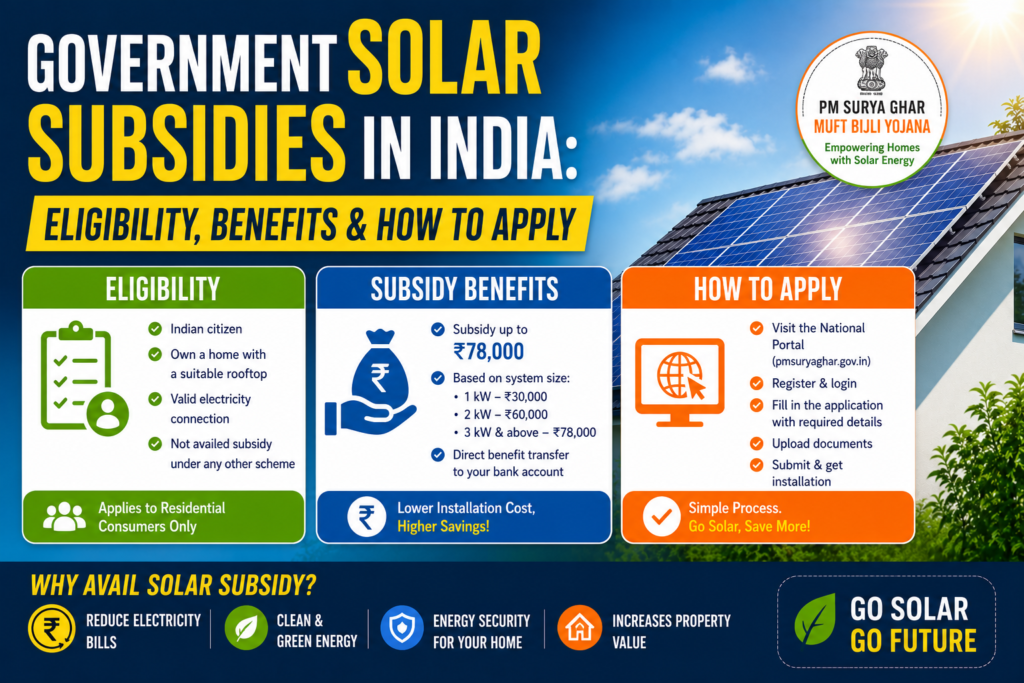
With electricity prices steadily increasing and the demand for clean energy growing, rooftop solar has become one of the most cost-effective investments for homeowners across India. To encourage the adoption of renewable energy, the Government of India has introduced several initiatives that make solar installations more affordable. The flagship program, PM Surya Ghar: Muft Bijli Yojana, provides financial assistance to eligible residential consumers for installing rooftop solar systems. Under the scheme, eligible households can receive Central Financial Assistance (CFA) for systems up to 3 kW, significantly reducing the upfront cost of installation.
Apart from reducing installation costs, the scheme helps homeowners lower their monthly electricity bills through net metering while contributing to India’s clean energy goals. However, many people are unsure about who qualifies, how much subsidy is available, which documents are required, and what the application process involves.
This comprehensive guide explains everything you need to know about government solar subsidies in India, including eligibility criteria, subsidy benefits, required documents, and the step-by-step application process.
1. What is the Government Solar Subsidy Scheme?
The Government of India promotes rooftop solar adoption through the PM Surya Ghar: Muft Bijli Yojana, administered by the Ministry of New and Renewable Energy (MNRE).
The primary objectives of the scheme are to:
-
Promote clean and renewable energy
-
Reduce household electricity expenses
-
Encourage rooftop solar adoption
-
Lower carbon emissions
-
Improve India’s energy security
-
Increase residential solar capacity
The subsidy is provided as Central Financial Assistance (CFA) and is credited directly to the beneficiary’s bank account after installation, inspection, and approval by the local DISCOM.
2. Who is Eligible for the Solar Subsidy?
The subsidy is available primarily for residential rooftop solar installations.
General eligibility requirements include:
-
You must be an Indian citizen.
-
You should have a residential property with a suitable rooftop.
-
The electricity connection should generally be in the applicant’s name.
-
The rooftop should receive adequate sunlight.
-
The installation must follow the official approval process using an empanelled vendor.
-
You should have a valid Aadhaar-linked mobile number and bank account for subsidy transfer.
The scheme is intended for residential consumers, while commercial and industrial installations are generally not eligible for residential subsidy benefits. Eligibility conditions are subject to the latest government guidelines.
3. Benefits of Installing Rooftop Solar Under the Subsidy Scheme
Government subsidies significantly reduce the initial investment required for a solar power system.
Some of the major benefits include:
-
Lower installation cost
-
Reduced electricity bills
-
Faster return on investment
-
Clean and renewable energy
-
Increased property value
-
Long-term energy savings
-
Reduced dependence on grid electricity
-
Support for India’s renewable energy mission
In addition to the subsidy, homeowners can benefit from net metering, allowing excess electricity generated by their solar system to be exported to the grid, helping reduce future electricity bills.
4. How Much Solar Subsidy Can You Get?
The amount of financial assistance depends on the size of the rooftop solar system and the applicable government benchmark.
Under the current scheme:
-
1 kW System: Up to ₹30,000
-
2 kW System: Up to ₹60,000
-
3 kW System or Above: Up to ₹78,000 (subsidy capped at 3 kW)
The subsidy structure currently provides higher support for the first 2 kW and additional assistance up to a maximum eligible capacity of 3 kW. Actual installation costs vary depending on equipment, location, and vendor pricing.
5. Documents Required for Solar Subsidy Application
Preparing the necessary documents in advance helps ensure a smooth application process.
Commonly required documents include:
-
Aadhaar Card
-
PAN Card (if applicable)
-
Latest Electricity Bill
-
Passport-size Photograph
-
Bank Account Details
-
Property Ownership Documents (where required)
-
Mobile Number linked with Aadhaar
Some states or DISCOMs may request additional documentation based on local procedures.
Before applying, verify the latest documentation requirements through the official portal or your electricity distribution company.
6. Step-by-Step Process to Apply for the Solar Subsidy
Applying for the rooftop solar subsidy is straightforward when you follow the official process.
Step 1: Register on the National Rooftop Solar Portal.
Step 2: Select your State and Electricity Distribution Company (DISCOM).
Step 3: Submit your rooftop solar application.
Step 4: Wait for technical feasibility approval.
Step 5: Choose an empanelled solar installation vendor.
Step 6: Install the approved rooftop solar system.
Step 7: Apply for net metering and system inspection.
Step 8: After successful verification, the subsidy is transferred directly to your bank account.
Following the official sequence is important, as installing a system outside the approved process may affect subsidy eligibility.
7. Common Mistakes That Can Delay Subsidy Approval
Many applications are delayed because of avoidable mistakes.
Some common issues include:
-
Applying with incorrect consumer details
-
Choosing a non-empanelled installer
-
Uploading incomplete documents
-
Incorrect bank account information
-
Installing the system before receiving feasibility approval
-
Delays in net metering inspection
-
Mismatch between application details and electricity connection records
Working with an experienced solar installer can help minimize these issues and speed up the approval process.
8. Tips to Maximize Your Solar Investment
Government subsidies reduce your initial investment, but long-term savings depend on choosing the right solar system.
Before installation:
-
Compare multiple solar quotations.
-
Choose Tier-1 solar panels.
-
Select a high-efficiency inverter.
-
Hire an experienced installer.
-
Ensure proper roof orientation.
-
Verify warranty coverage.
-
Plan for future electricity consumption.
-
Regularly monitor system performance.
A properly designed rooftop solar system can deliver reliable electricity for more than 25 years while significantly reducing energy costs.
Conclusion
Government solar subsidies in India have made rooftop solar more affordable and accessible than ever before. Through the PM Surya Ghar: Muft Bijli Yojana, eligible residential homeowners can substantially reduce the upfront cost of installing a rooftop solar system while enjoying lower electricity bills, long-term savings, and a cleaner source of energy.
To make the most of the scheme, ensure you meet the eligibility requirements, choose an empanelled installer, submit accurate documentation, and follow the official application process from registration to final inspection. Taking these steps will help you receive your subsidy smoothly and maximize the value of your investment.
If you’re planning to install rooftop solar, now is an excellent time to take advantage of government incentives and move toward energy independence. Consult a trusted solar installation company to assess your home’s energy needs and guide you through the subsidy application process.